· Adam Rizzo
Forearm strength as you get older: what changes, what trains, and what belongs to a doctor
Almost everything written about forearms is written for people in their twenties who want bigger arms. That is a fine reason to own a roller, and most of this site is about it. This guide is for the other conversation: the one that starts when a task your hands did without thinking takes a second attempt. What is going on, what is trainable, what "marker" actually means when researchers apply it to grip, and where the line sits between training and medicine.
What people notice first is a task, not a number
Nobody wakes up aware of their forearms. What people report is a list of small domestic defeats, and the list is remarkably consistent: the jar that needs a tea towel now, the second hand that joins the first on a full kettle, the suitcase handed over at the top of the stairs, the screwdriver re-gripped three times where it used to be turned once. The change rarely announces itself, because hands are good at hiding it: they recruit the other arm, swap to a wider grip, set the bag down and pick it up differently. That is why the noticing feels abrupt even when the change was not.
It is a mistake to read that as a verdict on the whole body. Hands are a special case: used constantly, loaded deliberately almost never. Nearly everything your grip does in a week is light, closed and repetitive; very little asks the hand to hold something genuinely heavy, and almost none of it asks the hand to open against resistance. That pattern produces a capable hand that is nonetheless untrained, at any age.
Why grip strength is the number a clinician reaches for
Grip is measured in clinics and in research for a practical reason: it is fast, it needs one small device, and it repeats the same way anywhere. The revised European consensus on sarcopenia, published by Cruz-Jentoft and colleagues in Age and Ageing in 2019, is explicit about the ranking it gives to strength: "In its 2018 definition, EWGSOP2 uses low muscle strength as the primary parameter of sarcopenia; muscle strength is presently the most reliable measure of muscle function." For identifying it, the same consensus states, "We advise use of grip strength and chair stand measures to identify low muscle strength," and notes that "because of its ease of use, grip strength is advised for routine use in hospital practice, in specialty clinical settings, and in community healthcare."
Here is the part that gets lost every time this reaches a headline. A marker is something a clinician reads. It is not a dial you turn. Grip strength is measured because it reports usefully on how muscle is doing across the body — which is exactly why the reading is informative, and exactly why improving the reading in isolation is not the point. Studies that find grip strength travelling alongside other health outcomes are describing an association, and an association is not a mechanism and not a promise. Nothing in that literature says that training your hands changes the outcomes the reading is associated with, and this site is not going to imply it.
The same consensus adds a detail that settles a related question: "Accurate measurement of grip strength requires use of a calibrated handheld dynamometer under well-defined test conditions with interpretive data from appropriate reference populations." In other words, it is a clinical measurement with a device, a protocol and reference data behind it. How a jar lid feels this morning is not that measurement, and neither is how much you can hang off a bar. Those are useful personal observations. They are not a self-administered test, and treating them as one produces false alarms in both directions.
What changes over a lifetime, and what is not a countdown
The shape of the curve is less dramatic than the internet suggests. The same 2019 consensus describes it plainly: "Muscle mass and strength vary across a lifetime — generally increasing with growth in youth and young adulthood, being maintained in midlife and then decreasing with ageing." A long arc with a maintained middle, not a cliff waiting at a birthday.
Two things in that consensus cut against the usual framing. The first is that age is not the whole explanation: the authors write that "sarcopenia has long been associated with ageing and older people, but the development of sarcopenia is now recognised to begin earlier in life, and the sarcopenia phenotype has many contributing causes beyond ageing." The second follows from it. If the causes are plural and the process starts long before anyone would call it age-related, then treating strength as something that happens to you after a certain decade misreads the timeline in both directions — it lets younger people ignore it and tells older people it is settled.
Where does that leave the forearms specifically? Reported plainly: the strength literature is written mostly about large muscle groups and whole-body function, and the hand-specific detail is thinner than the confident numbers circulating online suggest. What can be said without inventing anything is structural rather than statistical. The forearm is a dense collection of small muscles running to the wrist and every finger, it responds to loading the way other muscle does, and in most adult lives it carries the widest gap between use and training.
What the guidelines actually ask of you
This is where a lot of well-meaning content starts inventing programmes. There is a published national answer instead, and it is short. The Physical Activity Guidelines for Americans, 2nd edition (U.S. Department of Health and Human Services, 2018) states that "adults should also do muscle-strengthening activities of moderate or greater intensity and that involve all major muscle groups on 2 or more days a week, as these activities provide additional health benefits." The same document adds a key guideline written for older adults specifically: "Older adults should determine their level of effort for physical activity relative to their level of fitness." That second line does not say train less. It puts the reference point at your own current fitness rather than a table someone else wrote.
On what strength work is for in ordinary life, the National Institute on Aging puts it in terms of tasks rather than outcomes: "Muscle-strengthening activities improve physical function and can help you stay independent and make it easier to perform everyday activities, such as getting up from a chair, climbing stairs, and carrying groceries." Note what that sentence is and is not. It is about physical function and daily tasks, not about disease, and not about grip in particular — it covers muscle-strengthening activity in general. That is the precise scope of the evidence, and the scope this article stays inside.
Where a wrist roller fits
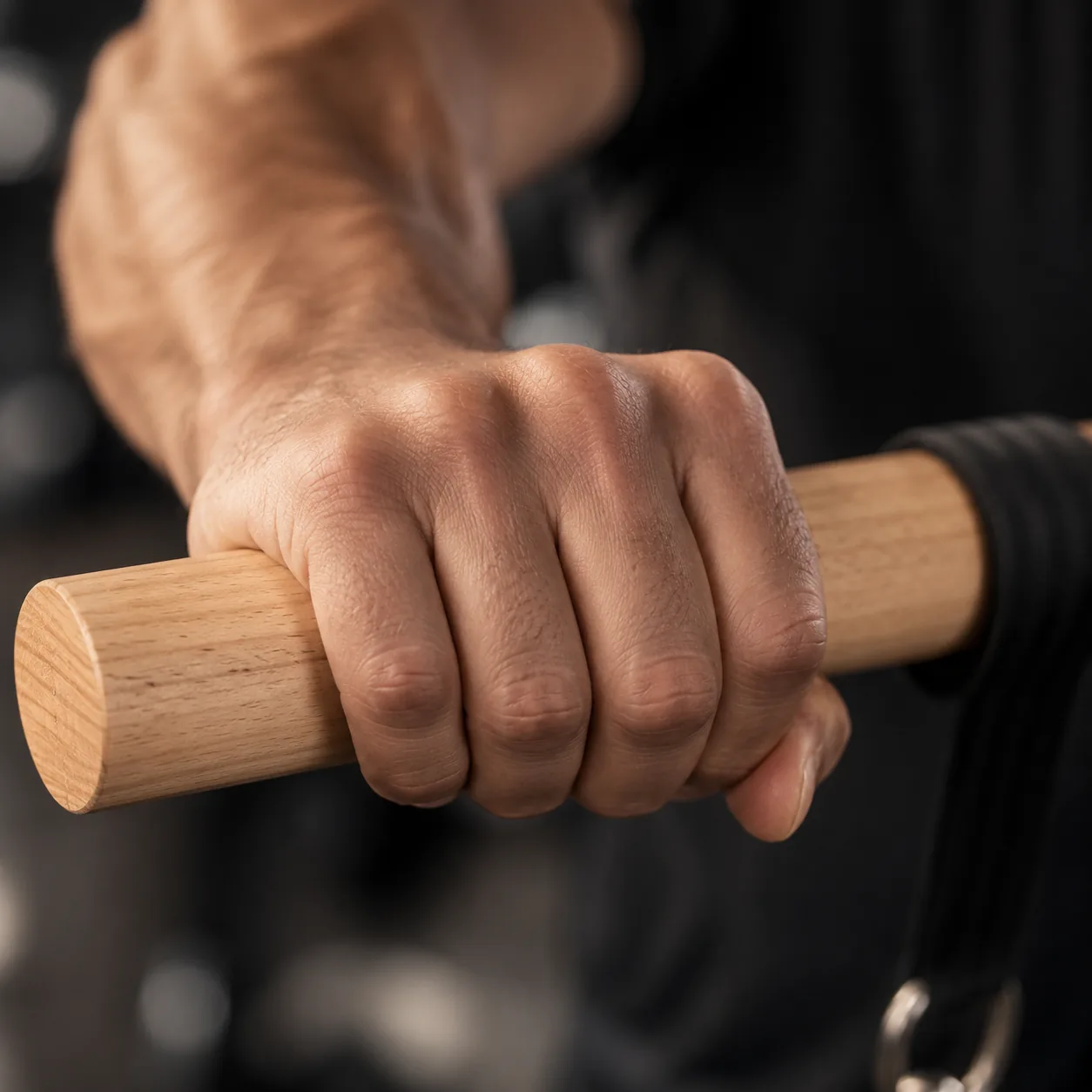
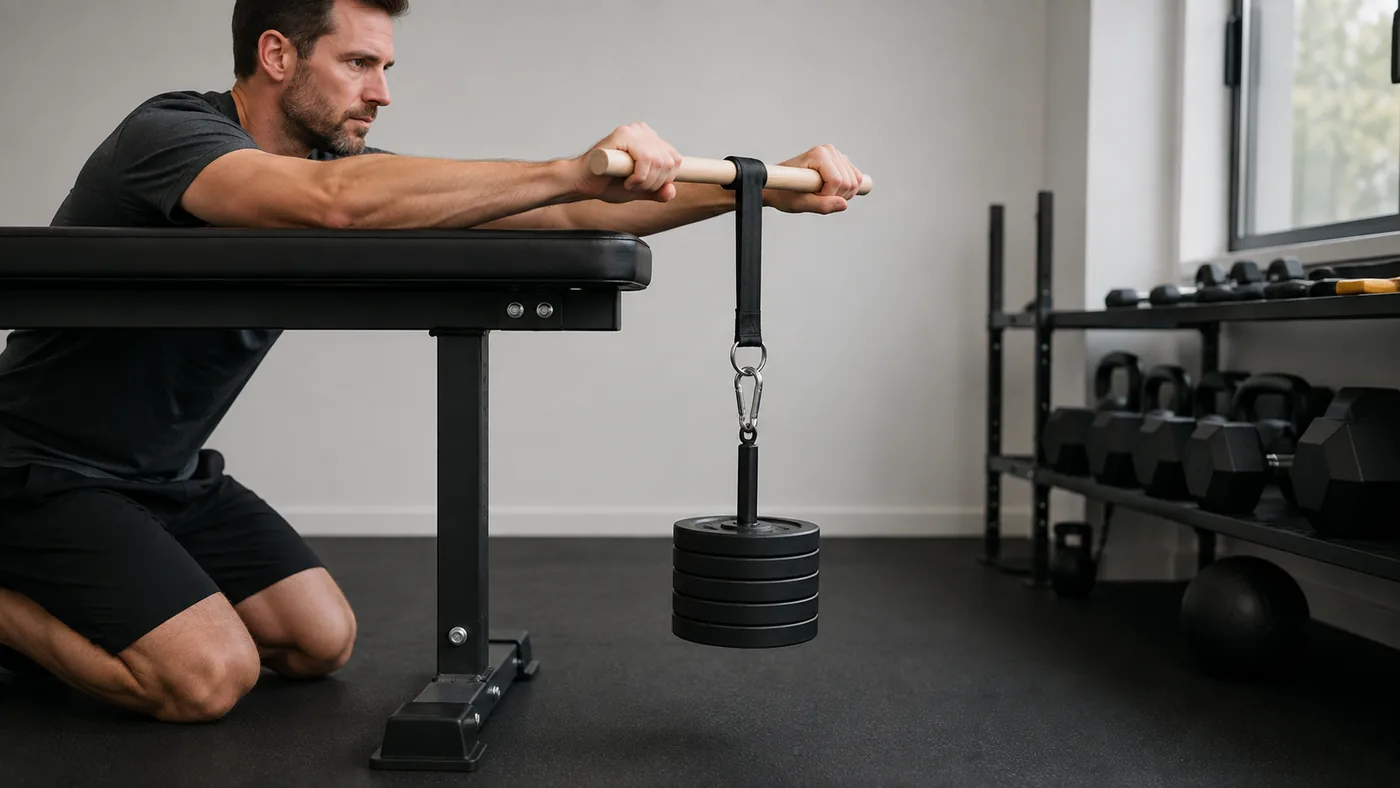
Against that background the case for rolling is narrow and specific, and it is about the mechanics of the movement rather than anything medical. Our Gripwood roller is a 15.7 in (40 cm) solid wood handle with a thickened nylon strap, a steel D-ring and a carabiner on the end. You clip a weight to the carabiner, wind it up by rotating the bar, then let it back down by rotating the other way. That is the entire machine: no springs, no resistance setting, nothing to set up.
Three properties of that design matter here. First, it trains the opening direction: winding the weight up and lowering it under control loads flexion and extension in the same continuous set, and extension is the direction a normal day almost never asks for — a point the benefits guide works through muscle by muscle. Second, the load is whatever you clip on, so the bottom of the range is genuinely low: a very small plate on a loading pin, or nothing at all on the empty strap while you learn the movement. Third, it needs no rack and no wall mount, so it lives in a drawer and comes out on the days it is used.
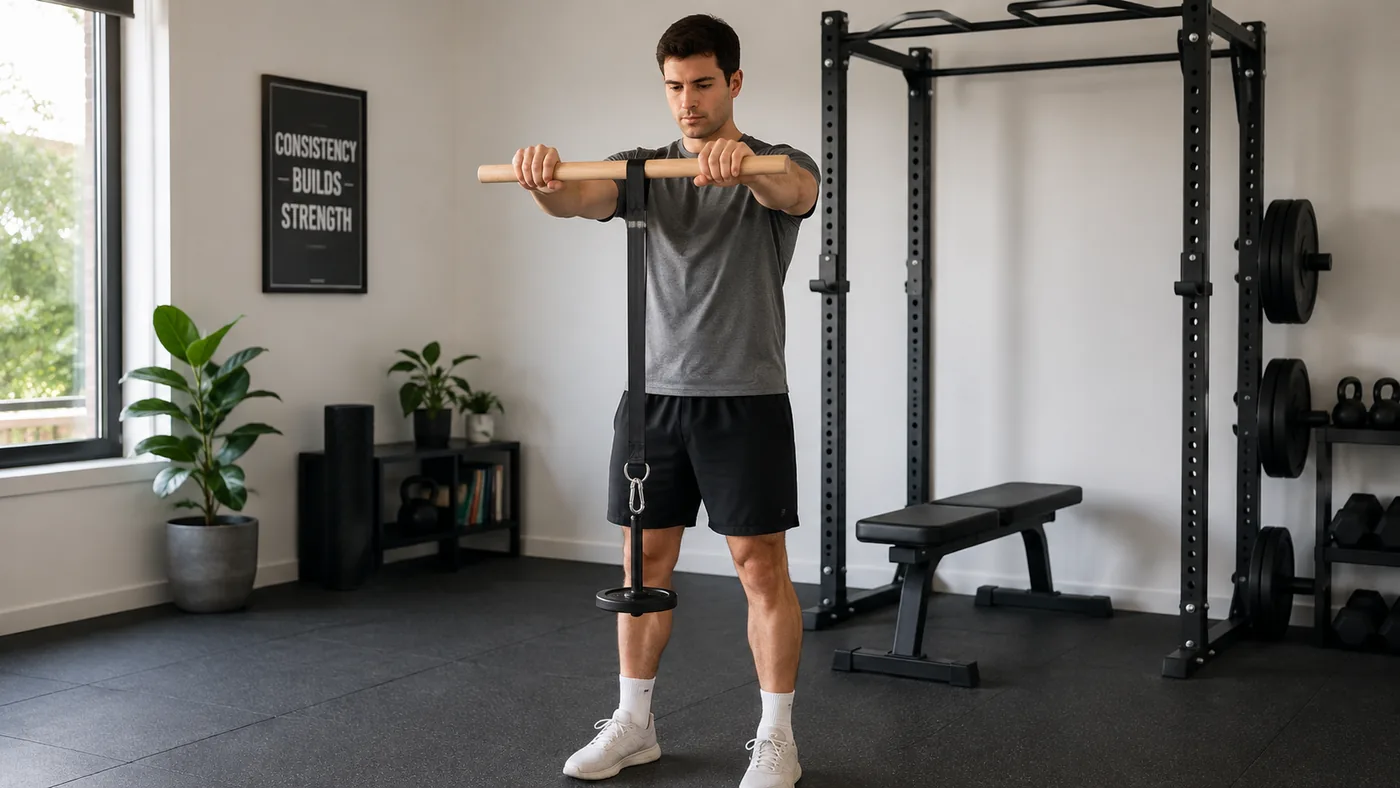
The position is adjustable too. Held out at shoulder height the set involves the shoulders, which is how most demonstrations show it. Resting the forearms on a bench with the wrists past the edge, as in the photograph above, leaves the work at the wrists and hands. The technique guide covers all three positions, and the seated one is an ordinary way to run the movement, not a reduced version of it.
Starting from the hands you have today
The most common mistake on this tool has nothing to do with age: loading it like a dumbbell. A long handle held at arm's length multiplies what a plate does at your wrists, so a weight that looks trivial on the floor behaves nothing like it on the strap. Our loading guide maps loads to levels and lists the five ways to attach one, and the entry point for anyone is the bottom of that ladder, whatever the rest of their training looks like.
Two other things are useful to know. Wrist tendons adapt more slowly than the muscles pulling on them, which argues for small increments over a satisfying jump after a good session. And the descent is where most of the work lives: lowering under control is harder than winding up. Neither point is age-specific, and both matter more when the plan is to still be rolling in five years.
Rolling is not the only pattern that reaches a forearm, and our complete guide to forearm exercises maps all five. What separates them is how far each can be loaded. A hang or a carry is capped by the weight your hand can already hold, so it stops progressing at exactly the point your grip does. A roller has no such ceiling: the next step is always one more small plate on the strap, which is why it still works in year three. The forearm exerciser guide ranks the family on that property.
When this is a question for a doctor, not a training tool
This section matters most, so it is short and unambiguous. A gradual, symmetrical change in what your hands manage is the ordinary background of strength. The following are not, and none of them is a training problem:
- Strength that drops quickly, over weeks rather than years.
- A clear difference between one hand and the other that you did not train for.
- Numbness, pins and needles, or burning in the hand or fingers.
- Pain in the hand, wrist, elbow or forearm, at rest or during ordinary use.
- Dropping things, fumbling buttons or keys, or a hand that does not do what you asked it to.
- Visible wasting of the muscle at the base of the thumb or between the fingers.
Any of those deserves a clinician rather than a plan, and deserves it before a new tool arrives, not after a few weeks of seeing whether training helps. Hand symptoms have many possible explanations, some straightforward to address, and sorting between them is a job for someone who can examine the hand and measure it with the dynamometer and reference data the European consensus describes. The Physical Activity Guidelines for Americans put the general version of this plainly: "Adults with chronic conditions or symptoms should be under the care of a health care provider."
The same applies in the other direction. A wrist roller is a piece of training equipment: a bar, a strap and a clip. It is not a medical device, it does not treat anything, and it should not be the first response to a symptom. Where it belongs is the ordinary category the guidelines describe — muscle-strengthening activity, chosen because you want the muscle it trains.
The part that is in your hands
Strip out everything that cannot be said responsibly and a clear picture is left. Clinicians measure grip because it reports well on muscle function, and reading a marker is their job, not yours. Strength across a lifetime is a long arc with a maintained middle. And forearms keep the largest gap between constant use and deliberate loading, at every point on that curve.
Closing that gap takes a tool that starts near zero and keeps going, which is what a bar, a strap and a carabiner have always been. The Gripwood wrist roller is $29.95 with free shipping and a 30-day money-back guarantee, and the routines page is there when you want a structure to follow. Give the muscles that have been carrying you the load they never get.