· Adam Rizzo
What weight should you put on a wrist roller?
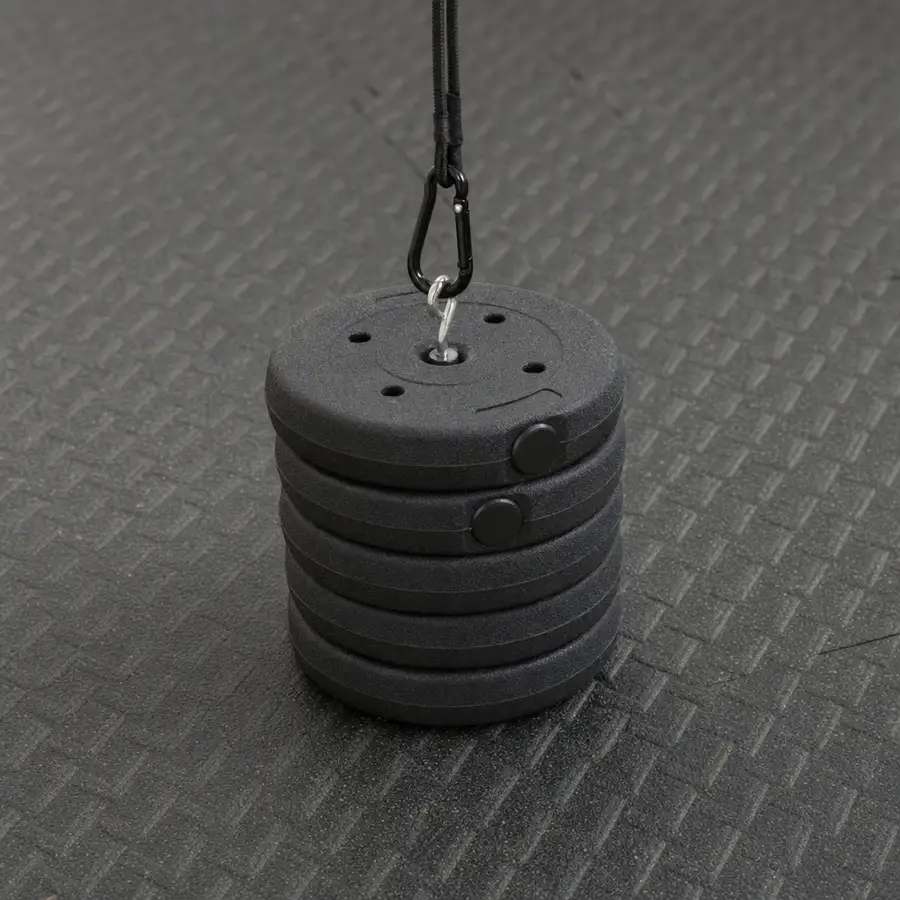
The number one email we get about the roller is some version of "what do I actually hang on this thing?" It is really two questions: how heavy, and attached how. Both answers below, including the options that cost you nothing.
How heavy: the level table
Leverage is why these numbers look modest. Held at arms' length on a long handle, a 10 lb plate produces far more strain at the wrist than the same plate in a curl. Ego is the main cause of abandoned rollers.
| Level | Load | You know you are ready when |
|---|---|---|
| Brand new | Empty strap, then 2.5 lb | Day one, everyone |
| Beginner | 5 lb | 3 full rolls feel smooth |
| Intermediate | 10-15 lb | You train pulls weekly already |
| Advanced | 20-25 lb | Slow eccentrics stay slow |
| Grip athlete | 25 lb+ | You compete or wish you did |
Progress by 2.5 lb at a time, exactly as the workout routines prescribe. If your lowering speed collapses at a new weight, the jump was too big. Consistency at modest loads is what moves the needle, which mirrors the baseline in the U.S. Physical Activity Guidelines (HHS, 2018): muscle-strengthening work at least 2 days a week, sustained, beats occasional heroics.
Attached how: your five options
| Load | How it attaches | Verdict |
|---|---|---|
| Plates on a loading pin | Carabiner clips the pin ring | The clean standard, nothing shifts |
| Kettlebell | Carabiner through the handle | Excellent, fixed jumps between bells |
| Dumbbell | Carabiner around the handle | Works, watch for sliding plates |
| Loaded backpack | Carabiner through the top loop | Free, great for travel, inexact |
| Plate tied directly | Strap through the center hole | Last resort, swings and spins |
The carabiner on the strap makes all five possible, and the loading pin exists because option one is the only setup where micro-loading with small plates stays tidy: stack, clip, roll. If your gym life already includes kettlebells, you may never need the pin, and we say so on its own page.
Does the load even matter that much?
For growth, tension and progression matter more than the absolute number. A 60-second roll with 8 lb produces more continuous forearm tension than most people's entire curl session. For long-term payoff, the evidence attaches to the quality you are building: in the PURE study of 139,691 adults (The Lancet, 2015), each 5 kg (11 lb) of grip strength difference was associated with a 16% difference in all-cause mortality risk. The plate you choose this week is a detail; rolling regularly is the decision.
Three loading mistakes to skip
Do not start at your curl weight: wrists are not biceps, and the leverage math is different. Do not hang a plate off a fraying shoelace: attachment failures happen at the bottom of the descent, right above your feet. And do not chase max weight before you own the slow unwind, because the descent is where the strength is built, as the technique guide explains step by step.
A note on micro-loading
The most useful purchase after the roller itself is a pair of small fractional plates. Forearm progress moves in small steps, and the jump from 10 to 15 lb can stall you for weeks where 10 to 12.5 would have sailed. Two 1.25 lb plates on the pin buy you those in-between rungs for pocket change, and they keep the ladder climbable all year.
If plates are not in your budget yet, the backpack route micro-loads for free: a water bottle weighs about 1 lb per pint (roughly half a kilo per half liter), so adding bottles one at a time gives you smaller jumps than any plate set. Weigh the loaded bag on a bathroom scale once, note the number, and your free setup progresses exactly as precisely as the paid one.